by Uredništvo | Mar 22, 2018 | Autorski osvrti, Edukacija, Istaknuto, Izvan Hrvatske, Manifestacije, Muzeji, Popularni, Susreti
Dr Vendi Jukic Buča, glavna urednica portala Arheologija.hr i GLAM volonter, održat će u subotu 24. ožujka interaktivnu prezentaciju svojeg grafički oblikovanog vodiča (Trail) tematski istaknutim artefaktima i umjetninama u muzeju Ashmolean u Oxfordu (Velika Britanija).
Prezentacija se održava u okviru programa obilježavanja nabavke slike Williama Dobsona ‘Group Portrait of Prince Rupert, Colonel William Legge and Colonel John Russell’ i 400. obljetnice rođenja Eliasa Ashmolea, osnivača Muzeja, a uključuje interaktivno predstavljanje ‘Traila’ te obradu izdvojenog motiva sa Slike, to jest dopunu praznog stola artefaktima iz fundusa Muzeja (Fillig up the Table).
Aktivnost je dizajnirana za djecu i odrasle.
Ulaz na cjelodnevni subotnji događaj je slobodan.
Vidimo se u Ashmoleanu!
*The Gardens, Libraries and Museums (GLAM) of the University of Oxford
https://www.ashmolean.org/sites/default/files/ashmolean/documents/media/ashmolean_press_release_-_william_dobson_acquisition_15.05.2017_v5.pdf
https://www.ashmolean.org/event/a-right-royal-adventure

Foto: poster grafički oblikovanog vodiča (Trail) o muzejskim tematski istaknutim artefaktima i umjetninama u muzeju Ashmolean u Oxfordu (Velika Britanija). Autorica dr Vendi Jukić Buča.
–
Dr Vendi Jukic Buca, editor-in-chief of the website Arheologija.hr and GLAM (The Gardens, Libraries and Museums (GLAM) of the University of Oxford ) volunteer, will undertake an interactive activity ‘Filling up the Table’ in the Ashmolean museum, on Saturday, 24th of March.
The activity is organised to celebrate the Ashmolean’s acquisition of the William Dobson’s painting ‘Group Portrait of Prince Rupert, Colonel William Legge and Colonel John Russell’ on the 400th anniversary of the birth of Elias Ashmole. This activity will include an interactive object handling and setting up the empty table (from the painting) and taking pictures following the Trail.
The activity is designed for both children and adults.
Free participation.
See you at the Ashmolean museum!
by dr. sc. Vendi Jukić Buča | Mar 1, 2018 | Autorski osvrti, Istaknuto, Izložbe, U Europi, UK
Na dan moga dolaska u Oxford, 19. listopada 2017. godine, u Ashmolean-u je otvorena izložba Imagining the Divine: Art and the Rise of World Religions. Radi intenzivnog volonterskog angažmana vezanog uz događanja u okviru GLAM-a (Gardens, Libraries and Museums of the University of Oxford) uspjela sam ju posjetiti tek dan prije zatvaranja.
Privremene izložbe postavljaju se u galeriji na trećem katu Muzeja, koja zauzima desno krilo etaže s izlazom u manju suvenirnicu (veća se nalazi na -1 etaži muzejske zgrade). Razgled stalnog postava Ashmolean-a je besplatan (donacija je dobrodošla), a za povremene izložbe treba kupiti ulaznicu čija cijena iznosi 10 funti (za 10 funti mogu se popiti otprilike 3.5 do 4 eat-in kave).
Imagining the Divine | Zamišljanje božanskog prezentira vizalnu kulturu najranijeg perioda najvećih svjetskih religija: budizma, kršćanstva, hinduizma, islama i židovstva. Autori izložbe su Jaś Elsner i Stefanie Lenk. Izložba je nastala kao rezultat novih istraživanja proizašlih iz suradnje kroz projekt Empires of Faith, s Britanskim muzejem i Sveučilištem u Oxfordu uz priloge vodećih znanstvenika s ciljem demonstracije fundamentalnog značaja vizualizacije u razvoju i objašnjenju religijskih ideja.
This is a groundbreaking show. Not just fabulous things to look at (though there are plenty of those) – but an attempt to raise big questions about how different cultures have made their gods visible to themselves, how the imagery was formed and evolved, and how different traditions of representation interacted with one another. It couldn’t be more relevant.
Konzultantica izložbe, klasičarka Mary Beard

Statue of Dionysus
Cyrene, Libya, 2nd century Marble, H 175cm
© Trustees of the British Museum
Ustupio: The Ashmolean Museum
–
Izložbom su prezentirani artefakti iz muzeja Ashmolean, ali i iz drugih brojnih muzeja, kolekcija i privatnih zbirki koje su posudile izloške (the British Museum, the Victoria & Albert Museum, National Institution Archaeological Museum of Macedonia, National Museum Scotland, Bodleian Library, British Library, the Nasser D Khalili Collection of Islamic Art, Sarikhani Collection, Corpus Christi College Cambridge, Lichfield Cathedral and Birmingham Museums Trust).
Izložba započinje prikazima rimskih božanstava (kovrčavi Jupiter), njihovom transformacijom u okviru asimiliranih orijentalnih kultova (kovrčavi Jupiter Serapis, kovrčavi rogati Jupiter Amon) i u konačnici razvojem u pojedine aspekte kršćanske simbolike (kovrčavi, ispočetka golobradi, a kasnije bradati, Krist).
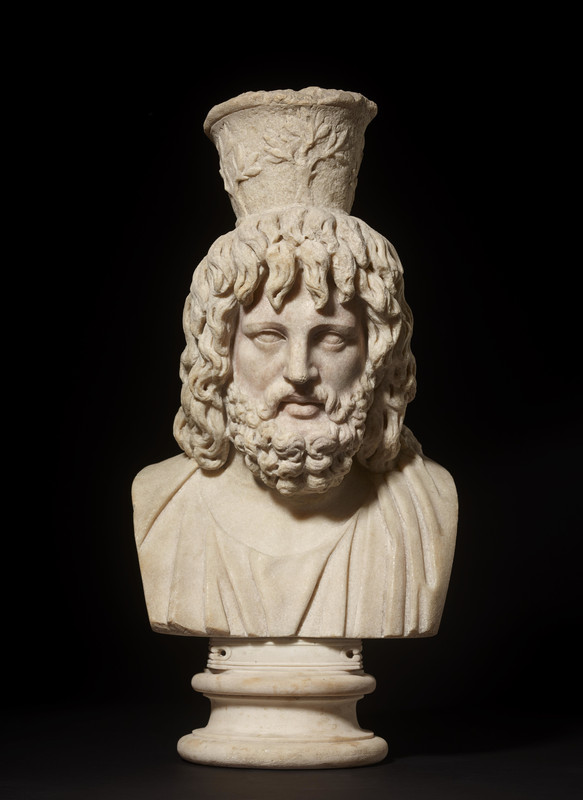
Bust of Jupiter Serapis
Roman Empire, 2nd century Marble, H 59cm
© Trustees of the British Museum
Ustupio: The Ashmloean Museum
–
Ovaj kontinuitet predočava i izrazito značajan najstariji prikaz Krista na području sjeverne Europe, svakako najstariji u Velikoj Britaniji u tehnici mozaka. Pronađen je u Hintonu, u crkvi Sv. Marije, kao dio veće cjeline. U pozadini se nalazi hi-ro monogram, koji označava prva slova imena Isusa Krista na grčkom jeziku. Ostali dijelovi mozaka bili su ornamenirani poganskim scenama što ukazuje na međusobno ispreplitanje simbolike.
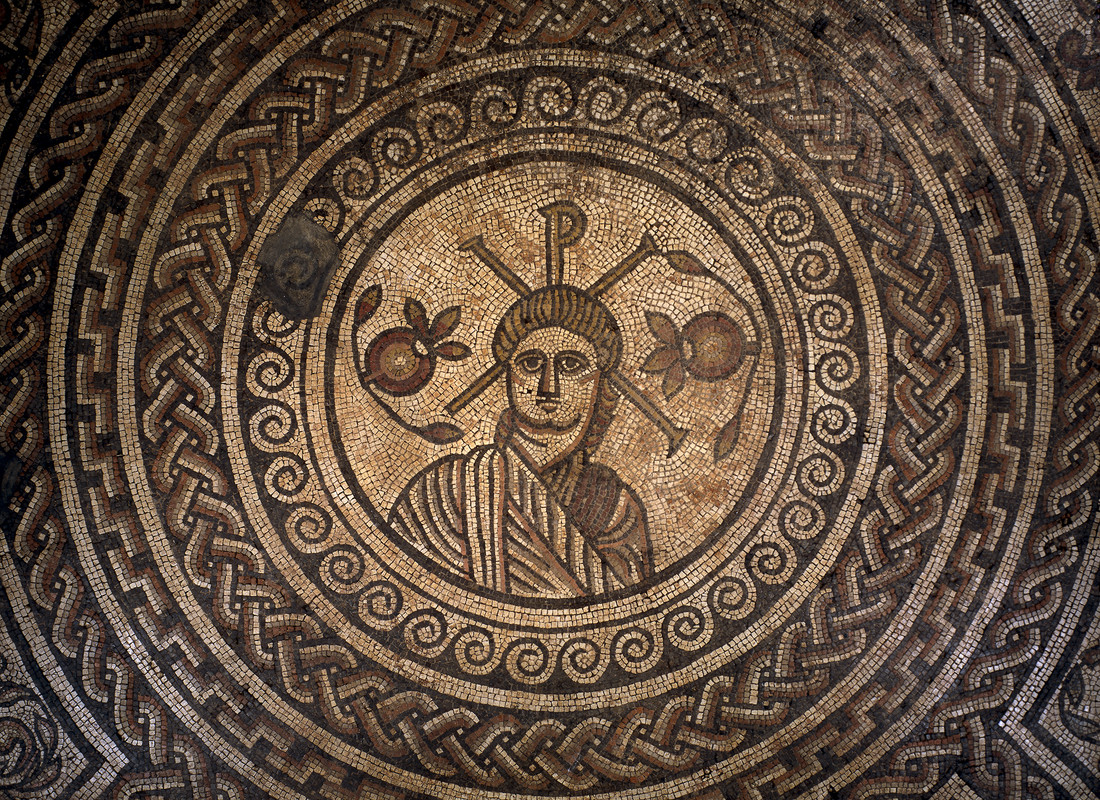
Central roundel from the Hinton St Mary Mosaic Dorset, early-4th century
© Trustees of the British Museum
Ustupio: The Ashmolean Museum
–
Osim rijetke kultne statue Dioniza iz 2. stoljeća, ističe se detaljno ornamentiran ulomak staklenog ovala a fondo d’oro iz Ashmolean-a, kakvih se nekoliko skromnijih primjeraka pronašlo i na području Dalmacije. Po prvi puta prezentirani su ranokršćanski sarkofazi iz Ashmolean-a.
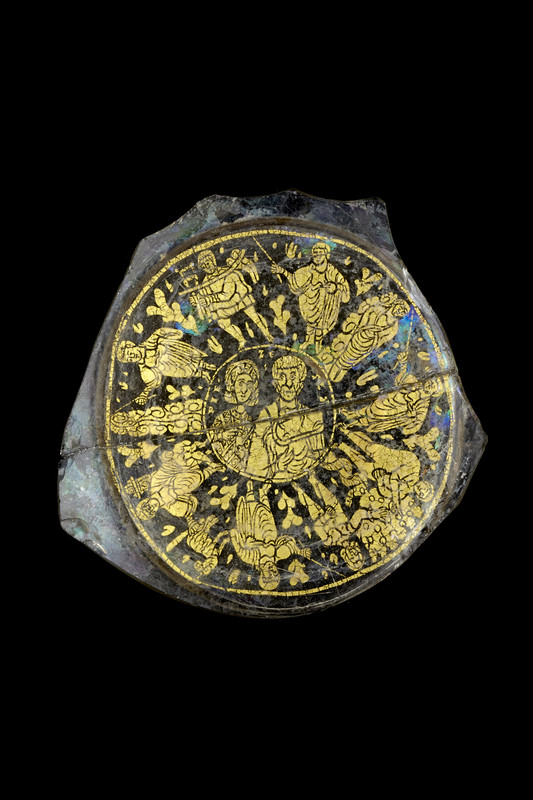
Base of an oval, gold-glass serving dish: a married couple surrounded by biblical scenes of salvation
Italy, 3rd-4th century
D 10.8 cm
© Ashmolean Museum, University of Oxford
Ustupio: The Ashmolean Museum
–
U nastavku su predočeni rani figurativni i predfigurativni prikazi Bude, poput Budinih stopala, svitci s prikazima deset avatara Višne, brončane i kamene skulpture Višne, te fotografija danas uništenog Bude iz Bamiyana. Izloženo je nekoliko najstarijih sačuvanih Kurana te kasnoantičkih židovskih artefakata. Ostali izlošci obuhvaćaju izbor različitih karata, svitaka, crteža, novaca, manuskripata, keramičkih posuda i posuda od plemenith metala te škrinja i amuleta.
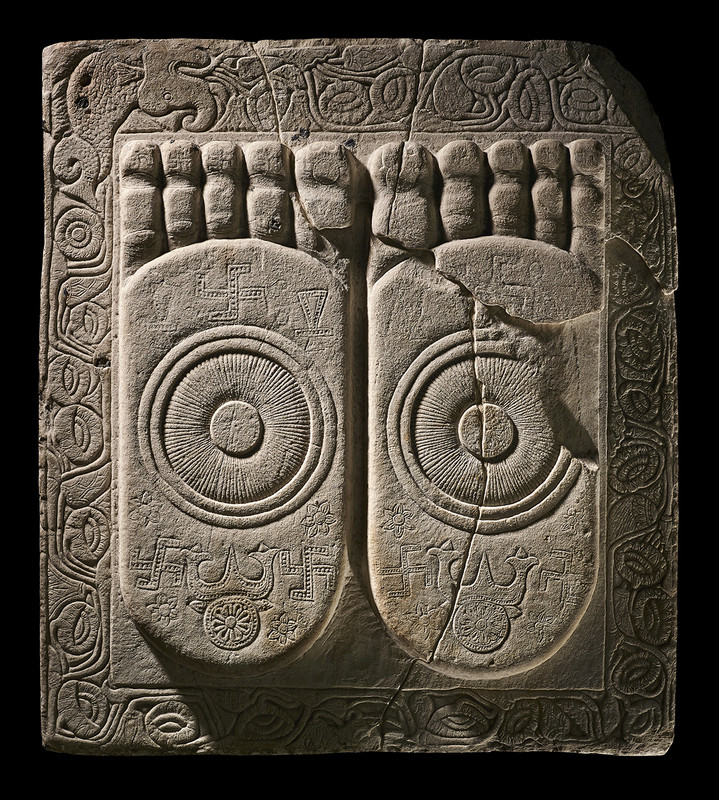
Footprints of the Buddha
Dome-slab sculpture carved on the front with Buddhapada (footprints of the Buddha), each foot bearing a dharmacakra (wheel of the law) and lotuses
Deccan, India, 2nd century
Carved stone, H 10.5 x W 64.8 x D 70.2 cm
© Trustees of the British Museum Central
Ustupio: The Ashmolean Museum
–
Posljednja prostorija posvećena je razvoju religije na Britanskim otocima. Ističu se kameni obostrano ornamentirani križevi te nakit, od kojih je zanimljiv tzv. Ballycottin Cross – fibula u bliku križa na čijem se križanju hasti nalazi islamski pečat, pronađena u mjestu Ballycottin u Irskoj. Postavlja se pitanje da li su kreatori artefakta znali o čemu se radi li su pečat smatrali lijepim kuriozitetom.

Ballycottin Cross – Brooch with cross and Islamic seal Found in Ballycottin, Ireland
Gilt copper alloy and glass, H 4.4 cm
© Trustees of the British Museum
Ustupio: The Ashmolean Museum
–
Izložba prezentira isprepletenost najvažnijih svjetskih religija, njihov međusoban utjecaj i interakciju.Zahvaljujemo The Ashmolean Museum na mogućnosti obilaska izložbe i ustupljenim fotografijama.
Vendi Jukić Buča
Oxford, 26. 2. 2018.
by Robert | Feb 26, 2018 | Arheološki muzej Istre, Arheološki muzej u Zagrebu, Autorski osvrti, Istaknuto, Monografije, Muzeji, Publikacije, Pula, Stručna literatura, U Hrvatskoj, Zagreb
Arheološki muzej u Zagrebu i Arheološki muzej Istre predstavili su monografiju ‘Mondokonja 2’ autorice Anje Hellmuth Kramberger.
Na press konferenciji održanoj 21. veljače 2018. u Velikoj dvorani Arheološkog muzeja u Zagrebu predstavljeno je izdanje Arheološkog muzeja Istre – Pula iz serije Monografije i katalozi 28, ‘Mondokonja 2’, u dvije knjige.

Anja Hellmuth Kramberger ; Foto RJ
Izdanje su predstavili gospodin Sanjin Mihelić, ravnatelj Arheološkog muzeja u Zagrebu i gospođa Anja Hellmuth Kramberger, autorica monografije.
Tema monografije ‘Monkodonja 2’ (Knjiga 2/1 – 2/2) je istraživanje protourbanog naselja brončanog doba Istre i keramika s brončanodobne gradine Monkodonja.
[Izvor Arheološki muzej Istre]
Predstavljena monografija 'Monkodonja 2' u dva toma, >http://film-mag.net/wp/?p=34999. Foto RJ
Objavljuje F.I.L.M. u 22. veljače 2018
by Robert | Feb 21, 2018 | Arheološki muzej Istre, Autorski osvrti, Hrvarsko arheološko društvo, Institucije, Institucije u Hrvatskoj, Istaknuto, Muzeji, Pula, U Hrvatskoj
U utorak, 20. veljače 2018. u 13:00 sati, u Velikoj dvorani Matice hrvatske, održana je dodjela Nagrada Hrvatskog arheološkog društva u organizaciji Hrvatskog arheološkog društva te Odjela za arheologiju i etnologiju Matice Hrvatske. Nagrade su proglašene tijekom održavanja znanstvenog skupa „Okolica Kaštelanskog zaljeva u prošlosti”, održanom u Kaštelima od 2. do 6. listopada 2017. godine.
Dobitnica nagrade za životno djelo „Don Frane Bulić“ je dr. sc. Kristina Mihovilić, muzejska savjetnica Arheološkog muzeja Istre u Puli.
Biografija
Dr. sc. Kristina Mihovilić rođena je u Puli 1951. godine. Diplomirala je arheologiju 1976. godine na Filozofski fakulteti Univerze v Ljubljani na Oddelku za arheologijo, a doktorirala na istom fakultetu 2001. godine s temom Starije željezno doba Istre. Od 1974. godine radi u Arheološkom muzeju Istre u Prapovijesnoj zbirci.
Participirala je na brojnim terenskim istraživanjima kao suradnica i voditelj: Nezakcij, Gradac – Turan, Sv. Martin (Lim.), Limska gradina, Pećinovac, Pećina na Gradini, Monkodonja, Mušego, Medulin – Punta Kašteja, Maklavun, Pula – AMI jug, Petrovac itd.
Radila je na postavljanju skupnih i samostalnih arheoloških izložbi: Arheologija i umjetnost Istre, Čarobna Istra, Nekropola Limske gradine, Grobnica Epulonovih predaka, Histria – Istra – Istrien, Histri i Etruščani, Monkodonja i Mušego, Histri u Istri i drugih.
Sudjelovala je s referatima na znanstvenim skupovima Hrvatskog arheološkog društva; Handel, Tausch und Verkehr im bronze – und früheisenzeitlichen Südoseuropa u Berlinu 1992.; Preistoria e protostoria del Friuli – Venezia Giulia e dell’Istria u Trstu 1994.; Grčki utjecaji na istočnoj obali Jadrana u Splitu 1998.; I Greci in Adriatico u Urbinu 1999.; I Celti nel Adriatico u Trstu 2001.; La pirateria nell’Adriatico antico u Veneciji 2002.; Carlo Marchesrri e i castellieri 1903 – 2003 u Duinu 2003.; Piceni ed Europa u Piranu 2006. itd.
Autorica je brojnih znanstvenih radova u hrvatskim i inozemnim publikacijama.
Održala je predavanja: Società di Minerva u Trstu, Institut für prähistorische Archäologie u Berlinu, Karl – Franzens Universität u Grazu; Centro Studi per l’Archeologia dell’Adriatico u Ravenni, Odsjek za arheologiju FF u Zagrebu, Oddelek za arheologijo FF u Ljubljani.
Kroz 42 godine radnog staža sudjelovala je u radu raznih tijela: član Uredništva muzejskih publikacija; član Stručnog vijeća, član Upravnog – muzejskog vijeća; voditelj prapovijesne zbirke, voditelj arheološkog odjela. U razdoblju 1995. – 1996., te od 2002. do 2006. obnašala dužnost ravnatelja AMI.
Članica je HAD-a i dopisni član Njemačkog arheološkog instituta.
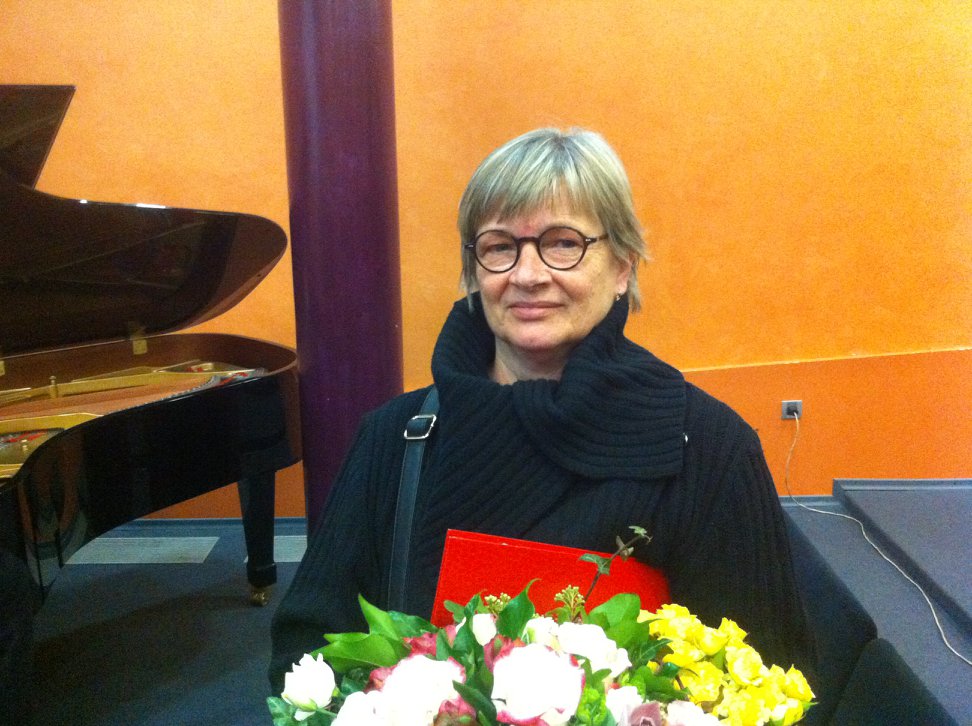
Dr. sc. Kristina Mihovilić, dobitnica Nagrade za životno djelo. Fotografija: Robert Jukić.
Dobitnici godišnje nagrade „Josip Brunšmid“ su akademik Nenad Cambj, prof. dr. sc. Miroslav Glavičić, prof. dr. sc. Željko Miletić i Joško Zaninović za knjigu „Antička baština na novčanicama mediteranskih zemalja“ u izdanju Nacionalnog parka Krka. Počasna članica Društva postala je Marina Šegvić.
Uz domijenak, program je obilježio nastup Tamare Jurkić Sviben na klaviru.
Program:
Žiga HIRSCHLER: Uspavanka, Majčin ples i Lutkino kolo
Antonio SMAREGLIA: Barcarola
Camille CHAMINADE: Nocturne op. 165
Izvor
HAD | AMI PRESS
by dr. sc. Vendi Jukić Buča | Feb 2, 2018 | Autorski osvrti, Istaknuto, Publikacije, Stručna literatura, Zbornici
Archaeopress Publishing Ltd, Oxford, 2016.
Web
Jezik: engleski
Stranica: 271
ISBN 978-1-78491-530-8
ISBN 978-1-78491-5315 (e-Pdf)
Galerija fotografija [foto: VJB]
Publikacija je dostupna u print i e-verziji. Obje verzije moguće je kupiti online: http://www.archaeopress.com/Public/displayProductDetail.asp?id=%7BC3D195D7-F3E0-4978-A8E2-1102FE8437F9%7D

Naslovnica Zbornika. Foto: VJB.
Zbornik ‘Croatia at the Crossroads – A consideration of archaeological and historical connectivity’ okuplja članke predavanja predstavljena tijekom arheološke konferencije (Europe House, 24. – 25. lipnja 2013.) organizirane u okviru festivala održanog s ciljem obilježavanja ulaska Hrvatske u Europsku uniju 1. 7. 2013. godine. Trodnevni festival društveih i kulturnih priredbi organiziralo je Britansko-hrvatsko društvo (British Croatian Society).
It was decided that the conference should not simply address the question of ‘recent archaeological work in Croatia’, even though this would have raised interesting questions concerning the state and condition of the archaeological discipline in Croatia. Instead it was considered to be more in tune with the spirit of the festival for the conference to consider the role which Croatia, or the lands of Croatia, had played as a conduit or connector in archaeological and historical periods between peoples, cultures and religions of northern and southern, western and eastern Europe. After all, Croatia is situated in central Europe and often stated to be positioned along the dividing or ‘fault’ lines of Roman and Byzantine, Ottoman and Christian cultures.
Iz Preface-a, David Davison, Chairman, British-Croatian Society, 2003-2010
Urednici Zbornika su David Davison, Vince Gaffney, Preston Miracle i Jo Sofaer.
Konferencija je prezentirala socijalne i kulturne poveznice hrvatske arheologije sa širom regijom kroz interdisciplinarne sadržaje i istraživanja. Naglasak je na arheološkom, povijesnom i geografskom položaju Hrvatske na području Europe i u okviru Europske unije.
Popis članaka
Preface (David Davison)
Foreword (urednici David Davison, Vince Gaffney, Preston Miracle i Jo Sofaer)
Ivor Janković, Fred H. Smith ‘Interactions in the Old Stone Age: Possible Scenarios Using the Vindija Biological Evidence’
This paper discusses the Neanderthal sequence from the Vindija cave, Croatia in the light of three main models of modern human origins. Over the last three decades these models have undergone much change, as new dates, fossils, cultural and genetic data became available. Vindija cave has yielded one of the latest Neandertal samples in Europe, and recent successful reconstruction of Neanderthal genome is based largely on three bones from this site. Thus, the remains from Vindija play a major role in any attempt to understand complex and dynamic patterns of biological and behavioural patterns of late Neandertals and their demise.
Ivor Karavanić ‘Contacts and Connections in Late Middle and Early Upper Palaeolithic Croatia’
This paper presents the most important late Middle and early Upper Palaeolithic sites in different regions of Croatia (Hrvatsko zagorje, Gorski kotar and Istria, Dalmatia). While there is evidence of contact between different groups of hunter-gatherers during the Middle/Upper Palaeolithic transition from Vindija Cave in continental (NW) Croatia, there is no such evidence in the Adriatic region. The first evidence of contacts between continental and Adriatic regions of Croatia comes from later periods (late Epigravettian, Mesolithic)
Dario Vujević ‘Adriatic Connections: Exploring Relationships from the Middle Palaeolithic to the Mesolithic’
The contribution explores cultural similarities and possible connections between the Palaeolithic sites on both sides of the Adriatic Sea. In the period from the Middle Palaeolithic Mousterian and through the Upper Palaeolithic Epigravettian Adriatic basin was not a barrier, but a connection of two presently separate geographical features: Italian peninsula and the Eastern Adriatic coast. Sites correspond closely in terms of economy, raw material choice, as well as typological and technological characteristics of artefacts, indicating a wide area of mobility.
Darko Komšo ‘The Mesolithic in Croatia’
Over the past five decades, the Mesolithic in Croatia has been recorded at numerous sites, some quite interesting and rich in various materials, even though others were improperly interpreted. Since the only true synthesis of this period was written as far back as 1979, the intention underlying this paper is to provide an overview of the changes which occurred in research conducted in the meantime, and to present the current status of knowledge on the Mesolithic in Croatia. The focus is placed on a critical overview and brief description of all recorded Mesolithic sites and the compilation of a list with all available literature. (…)
Jacqueline Balen ‘The Development of Eneolithic Cultures Between the Sava and Drava Rivers’
The eastern Croatian region occupies the southwestern part of the Panonian Basin and the eastern part of the area between the rivers Sava and Drava. This area as an enclosed geomorphic unity, its location and natural roads, fluvial valleys and waterways is closely associated with the adjacent areas. During the Copper Age in northern Croatian (more specifically in the area bounded by the rivers Sava, Drava and Danube) we can continuously follow the development of major cultures, such as the Lasinja, Retz-Gajary, Baden, Kostolac and Vučedol. However during this period there are also influences (and/or the presence) of some additional cultures, such as the Lengvel and Bodrogkeresztur.
Helena Tomas ‘Croatia and the Crossroads of Early Greek Seafarers’
The earliest Greek seafarers to reach the coasts of the Adriatic date from the Late Bronze Age, and are better known as the Mycenaeans. They were skillful and adventurous traders who knew no geographical limits in their search for raw materials around the Mediterranean basin. Indications of their presence have been discovered all over the eastern and central Mediterranean, with some hints even in the western portion of the basin. Numerous sites with Mycenaean material, primarily pottery, have likewise been identified along the western coast of the Adriatic, reaching all the way to the Po Valley. (…)
Sanjin Mihelić ‘Multiculturalists Before We Knew It: Keeping Pace with Bronze Age Trends’
The paper discusses current approaches and possible alternatives in correlating spatially bounded distributions in the Middle Danube area in Croatia, Hungary and Serbia with our notions of prehistoric identities based in the study a number of elements of presumptive relevance in the self-conceptualization and expression of social identity. This is juxtaposed to the conceptual framework that reserves the pride of place in the phenomenology of bearers of collective identity for archaeological cultures as the basic units of study, pointing out some of the limitations of this approach.
Darko Maričević ‘Clay Birds as Religious Objects and Works of Craft in the Bronze Age and the Early Iron Age of the Balkans and the Carpathian Basin’
During the Bronze Age and the Early Iron Age many European communities adopted similar iconographic themes through shared cosmological understanding of the world and perhaps religious practice too. Different combinations of solar, anthropomorphic and ornithomorphic imagery, in particular, occur repeatedly in different locations at different times during this period, not least along the southern margins of the Carpathian Basin and the northern Balkans. (…)
Hrvoje Potrebica ‘The Princess of the Crossroads – The Early Iron Age in Northern Croatia’
The diverse and intensive dynamics of the cultural development were caused by the exceptional geographic diversity of Croatia’s territory In the majority of archaeological periods, Croatia or some of its parts were liminal areas for various archaeological contexts. One of the best examples of this is the Iron Age in northern Croatia. Although five distinct cultural groups were identified in this area in modern archaeological literature, the Kaptol cultural group is the key cultural phenomenon of the Early Iron Age in Northern Croatia. (…)
Vedran Barbari ‘Indigenous Pottery in Dalmatia During the Last Millennium BC’
In this paper an attempt is made to define and clarify some issues on the indigenous pottery present in the area of Dalmatia during the last millennium BC. The area of Dalmatia covers large part of the eastern Adriatic cost, from the mountain Velebit in the north down to the Boa Kotorska bay in the south. Indigenous pottery fragments make up by far the largest portion of all the finds from the Iron Age settlement excavations in the area, but no elaborate attempts have been made so far in studying this class of archaeological finds.
Branko Kirigin ‘Salona and the Sea – Some Observations’
The maritime aspects of Salona, the capital of the Roman province of Dalmatia, has been totally ignored in scholarship. This paper deals with the geography; why Salona and not Split; the origin of Salona; the port of Salona; and the problems if how trade sailing boats navigated within the Bay of Kaštela, coping with winds and other dangers. (…)
Branka Migotti ‘Interaction Between Incomers and Autochthons on Roman Funerary Stones from the Croatian Region of Pannonia (1st-4th Centuries)’
It appears that the volume indicators (i.e. routes and channels of communication manifest through trade, technological transfer, artistic influence, religion, conflict, etc.) for the Roman period can be very conveniently illustrated by a selection of funerary stones, especially those featuring both portraits and epitaphs. Although a Roman conception in itself, the funerary stone soon became a means of display of various interactions between local Pannonians and both the Romans and incomers from other areas of the Empire.
Ivan Radman-Livaja ‘Immigrants from Other Areas of the Roman Empire Documented on Siscia Lead Tags’
While most Roman lead tags from Siscia kept in the Greek and Roman Department of the Zagreb Archaeological Museum contain information about individuals who appear to be clients of local fuller and dyers, some also provide more or less credible data about those clients’ likely origins. Inscriptions normally specify information about the garments, the service to be completed and the amount of money asked for payment, but the craftsmen also had to know to whom to return the merchandise. (…)
Ante Škegro ‘New Knowledge on Certain Early Christian Dioceses in the Eastern Adriatic Region’
The results are presented of the most recent research into Early Christian dioceses in the regions that were part of the Roman province of Dalmatia. It has come to light that four of these, having been cited in the literature from the time of Daniele Farlati (1690-1773) to the present, did not exist; eight dioceses had seats in places located along the eastern Adriatic maritime route (Salona, Iader, Arba, Epitaurum, Catharum, Scardona, Senia, and Muccurum); bishops of three dioceses resided in settlements located along the main road from Aquileia (northeastern Italy) to Constantinople (Byzantine capital) in the eastern Adriatic hinterland (Naronitan, Sarsenterensis, Ludroennsis). (…)
Ante Milošević ‘The K-type Sword from Koljane in Dalmatia as Possible Evidence for the Arrival of Croats at the End of the 8th Century’
During the last decade several interesting pieces of weaponry and military fear have been found in the valley of the Cetina river. In general, they exhibit morphological and typological features typical for the early Carolingian times. Among such finds is a sword with silver belt buckle from Koljani, which is a third such find coming from the small area around Vrlika, situated in the hinterland of Dalmatia. It can be argued that the sword represents a good from an unknown grave which has now been obscured by the artificial lake created for the hydro-power station Peruča. (…)
Irena Radić Rossi, Mariangela Nicolardi, Katarina Batur ‘The Gnalić Shipwreck Microcosm of the Late Renaissance World’
In the early 1960s, local divers discovered an outstanding shipwreck site, near the small island of Gnalić at the south-western entrance of the Pašman Channel. Subsequently, several archaeological interventions in the late 1960s and early 1970s, and one in 1996, rescued part of the archaeological remains of a large merchantman, dated to the late 16th century. The extent of the site and he excellent preservation of the ship remains and its cargo make it one of the most interesting post-mediaeval shipwrecks known. (…)
Dora Bošković ‘Weapons of the Military Frontier in Croatia from the End of the 17th to the End of the 19th Century – Combat Equipment and Emblems of Rank’
In the period from the 17th until the second half of the 19th century the territory of today’s southern and southeastern Croatia was the borderland of the Habsburg Monarchy, neighbouring the Ottoman Empire and Venetian Republic. In that borderland – known as the Military Border or Triple border (Triplex confinium) – three completely different civilizations interfered, mingled and pervaded. (…)
Publikacija je velikih dimenzija. Sadrži brojne fotografije u boji, crteže, table i karte.
Zahvaljujem izdavaču Archaeopress-u na ustupljenom primjerku.
Vendi Jukić Buča
Oxford, 30. 1. 2018.
by dr. sc. Vendi Jukić Buča | Feb 2, 2018 | Autorski osvrti, Istaknuto, Priručnici, Publikacije, Stručna literatura
Archaeopress Publishing Ltd, Oxford, 2017.
Web
Jezik: engleski, hrvatski
Stranica: 126
ISBN 978-1-78491-566-7
ISBN 978-1-78491-567-4 (e-Pdf)
Galerija fotografija [foto: VJB]
Publikacija je dostupna u print i e-verziji. Obje verzije moguće je kupiti online: http://www.archaeopress.com/Public/displayProductDetail.asp?id=%7B49B136AC-0BCA-4F29-B58F-3C6269F04F3E%7D
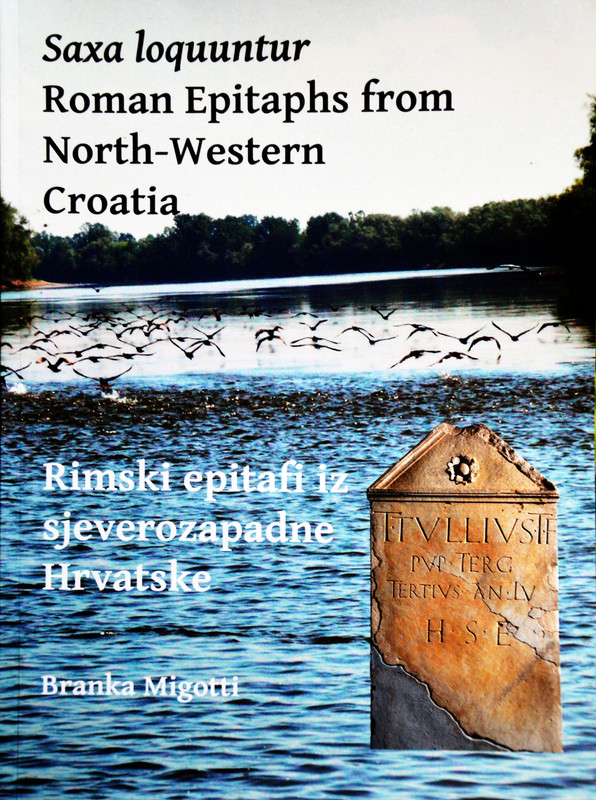
Naslovnica Pubikacije. Foto: VJB.
Publikacija ‘Saxa loquuntur – Roman Epitaphs from North-Western Croatia | Rimski epitafi iz sjeverozapadna Hrvatske’ predstavlja sukus rezultata istraživanja rimskih epitafa s područja sjeverozapadne Hrvatske namijen opularizaciji znanosti u okviru projekta ’Roman funerary monuments of south-western Pannonia in their material, social, and religious context’ (IP-2014-09-4632) voditeljice Branke Migotti.
Autorica je dr. sc. Branka Migotti, znanstvena savjetnica u trajnom zvanju zaposlena na Odsjeku za arheologiju HAZU na poziciji upraviteljice Zavoda za povijesne i društvene znanosti u Zagrebu, Odsjeka za arheologiju te vanjska suradnica na doktorskom studiju arheologije, na Odsjeku za arheologiju Filozofskog fakulteta Sveučilišta u Zagrebu.
Na početku Publikacije navedeni su dvojezični Popis slika te Zahvale, nakon čega je podijeljena na dva zasebna dijela. Prvi dio obuhvaća tekst na engleskom jeziku, a drugi na hrvatskom. Obje cjeline sadrže identične slikovne priloge i podjelu prema poglavljima: nakon Uvoda slijede Trgovina i rat, Veterani ili njihove sudbine, Panonska vojnička ‘elita’, Stogodišnjaci, Robovi, ‘Ženski svijet’ – rimska žena između samosvijesti i patrijarhata, Smrt i mitologija, Od mita prema kršćanstvu te Epilog. Kroz osam poglavlja predstavljeno je trinaest spomenika iz razdoblja od 1. do 4. stoljeća.
Fraza saxa loquuntur (kamenje govori) postala je kulturološka krilatica modernog doba zahvaljujući čuvenom austrijskom neurologu i psihoanalitičaru Sigmundu Freudu (1856.-1939.). Kažu da je taj strastveni i uspješni sabirač starina klasične antike sam sebe nazivao arheologom duše, a metoda arheološkog istraživanja nadahnula ga je za spomenutu frazu, jednu od najzvučnijih metafora u razrađivanju modela otkrivanja ljudske duše. Iza nje krila se znanstvena paradigma za koju se Freud nadao da će biti razumljiva njegovim čitateljima, a odnosila se na usporedbu slojeva zemlje i slojeva ljudskog duha: zemlju razgrće arheolog u potrazi za materijalnim ostatcima ljudske civilizacije, dok psihoanalitičar na sličan način prodire u slojeve ljudske duše i uma u potrazi za izvorima duševne patnje pojedinca.
Iz Uvoda
Publikacijom su predstavljeni grobni spomenici s epitafima koji potječu iz triju rimskih gradova sa prostora jugozapadnog dijela nekadašnje rimske provincije Panonije: Andautonije (Andautonia, Ščitarjevo kod Zagreba), Siscije (Siscia, Sisak) i Akva Balisa (Aquae Balissae, Daruvar). Ovi kameni grobni spomenici, s natpisima i reljefima, pridonose saznanjima o životu tijekom rimskog razdoblja na području današnje sjeverozapadne Hrvatske.
To obraćanje može sadržavati razne podatke o pokojniku, od kojih su neki jasni i nedvosmisleni i današnjem promatraču, dok druge treba iščitavati između redaka: jesu li ti ljudi bili domaći ili ‘pravi’ doseljeni Rimljani, kako su se uklopili u provincijalno-rimsko društvo, jesu li tragove svoje izvorne etničke pripadnosti sačuvali u imenima ili odjeći, kakav im je bio društveni položaj, čime su se bavili, kojim se bogovima ili Bogu obraćali, kako su izrazili odanost rimskim vrijednostima, kako su željeli biti zapamćeni na svojim spomenicima, kako su izražavali bol gubitka… Upravo radi naglaska na takvim sadržajima za naslov knjige izabrana je sintagma iz psihološke literature.’
Iz Uvoda
Analiza obuhvaća povijesni i arheološki kontekst uz prijedlog čitanja natpisa te njegovog prijevoda. Tumači se kontekst života pokojnika te namjena određene formulacije epitafa. Donose se usporedbe sa sličnim spomenicima s drugih (domaćih i inozemnih) lokaliteta te poznati primjeri u literaturi.
Publikacija sadrži brojne fotografije u boji, crteže i karte.
Zahvaljujem izdavaču Archaeopress-u na ustupljenom primjerku.
Vendi Jukić Buča
Oxford, 30. 1. 2018.