by PRESS | May 24, 2024 | Arheološki muzej u Zagrebu, Istaknuto, Lokaliteti, Manifestacije, Muzeji, Popularni, PRESS, Susreti, U Hrvatskoj, Zagreb
DANI ANDAUTONIJE u povodu 30 godina Arheološkog parka Andautonija u Ščitarjevu
subota 25. i nedjelja 26. svibnja 2024.
Arheološki park Andautonija u Ščitarjevu
Arheološki muzej u Zagrebu
Trg Nikole Šubića Zrinskog 19
Zagreb
Press informacija, 20. svibnja 2024.
U povodu 30 godina Arheološkog parka Andautonija u Ščitarjevu, Arheološki muzej u Zagrebu organizira manifestaciju DANI ANDAUTONIJE koja će se održati u subotu 25. i nedjelju 26. svibnja 2024.
Tijekom manifestacije DANI ANDAUTONIJE ulaz u arheološki park je besplatan, a dobrodošli su i kućni ljubimci.
Tijekom dva dana, svi posjetitelji moći će besplatno sudjelovati u brojnim radionicama i igraonicama (govorništvo, izrada keramičkih posuda, uljanica, klesanje, rimske igre, izrada bula, pisanje, rimska moda, mali arheolozi i dr.), a biti će organizirana i stručna vodstva, predavanja i koncerti te će se pripremati hrana prema rimskim receptima. Uz interaktivnu izložbu Rimski mirisi posjetitelji će i sami moći izraditi uljne parfeme od sastojaka koje su koristili i Rimljani. Uz brojne vanjske suradnike u programu manifestacije sudjelovat će i učenici OŠ Ščitarjevo te Udruga žena Ščitarjevo.
U nedjelju 26. 5. organiziran je besplatan prijevoz iz Zagreba za Ščitarjevo i povratak u Zagreb (polazna i dolazna stanica na Zrinjevcu kod meteorološkog stupa).
Termini:
11.30 Zagreb-Ščitarjevo
14.30 Ščitarjevo-Zagreb
15.00 Zagreb –Ščitarjevo
18.00 Ščitarjevo-Zagreb
PROGRAM SUBOTA, 25. SVIBNJA OD 12 DO 19 SATI
Od 12 do 18 sati- radionice:
-izrada keramičkih posuda, uljanica, tkanje i dr.
-Slova u kamenu- radionica klesanja (voditelj ak. kipar Vid Vučak)
-Zodijak u antičkom Rimu (voditeljica dr. sc. Ivana Ožanić Roguljić)
-Izmiješaj „rimski“ parfem- (voditeljica Katica Wolf, aromaterapeut)
13 sati – predavanje „u voćnjaku“:
Rujana Jeger: Veza jača i od smrti – zajednički ukopi ljudi i pasa kroz prostor i vrijeme
16 sati – RADIONICA GOVORNIŠTVA
Putovanje u umijeće govorenja rimskim stilom- radionica govorništva (pod vodstvom Denivera Vukelića)
17 sati – Koncert na rimskoj cesti
Tonko Marković, violončelo – J. S. Bach: suita za violončelo u C-duru, BWV 1009
Od 18 sati – Koncert grupe Car je gol i druženje uz rimsko vino
PROGRAM NEDJELJA, 26. SVIBNJA OD 12 DO 18 sati
Od 12 do 18 sati
– radionice:
– izrada keramičkih posuda, uljanica, tkanje i dr.
– Slova u kamenu- radionica klesanja (voditelj ak. kipar Vid Vučak)
– Izmiješaj „rimski“ parfem- (voditeljica Katica Wolf, aromaterapeut)
– Rimske priče u Andautoniji – pripovjedna predstava (Srebrenka Peregrin Pavlaković)
13 sati – Koncert na rimskoj cesti
Tonko Marković, violončelo – J. S. Bach: suita za violončelo u C-duru, BWV 1009
16 sati – predavanje „u voćnjaku“:
Rujana Jeger: O vješticama i crnim psima – podrijetlo predrasuda
[AMZ PRESS]

by PRESS | May 24, 2024 | Arheološki muzej u Zagrebu, Izložbe, Muzeji, PRESS, U Hrvatskoj, Zagreb
Tko smo, gdje smo i što sve čuvamo?
PROZOR U AMZ
10. ožujka – 9. lipnja 2024.
Prolaz neboder
Ilica 1c
Zagreb
Arheološki muzej u Zagrebu
Trg Nikole Šubića Zrinskog 19
Zagreb
Press informacija, 12. ožujka 2024.
Arheološki muzej u Zagrebu u prolazu Iličkog nebodera postavio je prvu izložbu projekta PROZOR U AMZ – Tko smo, gdje smo i što sve čuvamo?.
Tko smo, gdje smo i što sve čuvamo? prvo je i uvodno izdanje izložbenog projekta PROZOR U AMZ koje je posvećeno upoznavanju s našom zgradom, njezinom poviješću, ali i s tradicijom te radom stručnih odjela Arheološkog muzeja u Zagrebu. Kroz replike nekih od naših najpoznatijih nalaza, pružamo vam pogled u stalni postav našeg Muzeja kakav je bio prije potresa 2020. godine, osobito zbog toga što ćete ga uskoro moći vidjeti u novom ruhu.
U sljedećim izdanjima PROZOR U AMZ pružit će vam uvid u tajne koje se kriju unutar, ali i izvan stalnog postava Muzeja, u prostorima kao što su čuvaonice i radionice koje inače nisu dostupne posjetiteljima. Osim toga, upoznat ćemo vas i s dijelom onoga što arheolozi rade kada su na terenu, ali i nakon što tereni završe, a mi se vratimo u urede.
Javite nam se s pitanjima, idejama i prijedlozima, možda baš ono što Vas zanima postane jedna od sljedećih tema.
Ovim putem pozivamo naše sugrađane i našu publiku, sve zaljubljenike u arheologiju, da nam se jave, jer možda baš ono što njih zanima postane jedna od sljedećih tema izložbenog projekta PROZOR U AMZ.
Radujemo se vašim idejama i prijedlozima koje možete poslati online putem društvenih mreža, ili na mail amz@amz.hr. Također nam možete pisati na Arheološki muzej u Zagrebu, P.P. 28, 10000 Zagreb.
PROZOR U AMZ novi je izložbeni projekt Arheološkog muzeja u Zagrebu putem kojeg želimo s publikom podijeliti dio onoga tko smo, što smo, gdje smo i što zapravo radimo. Naš „prozor“ nalazi se u Prolazu neboder, na adresi Ilica 1c u Zagrebu
Tko smo, gdje smo i što sve čuvamo?
PROZOR U AMZ
10. ožujka – 9. lipnja 2024.
Prolaz neboder, Ilica 1c, Zagreb
Impresum:
Autorica postava: Ana Đukić
Grafičko oblikovanje: Srećko Škrinjarić
Tehnička izvedba izložbe: Robert Vazdar, Ana Đukić
Izrada replika predmeta: Vedran Mesarić
Marketing i odnosi s javnošću: Sanja Mijač, Davorka Maračić
Izložbeni ormarić na korištenje ustupio je Gradski ured za obnovu izgradnju, prostorno uređenje, graditeljstvo i komunalne poslove; Odjel za korištenje i zakup javnih površina, reklame i uređenje javnih gradskih prostora; Odsjek za korištenje i zakup javnih površina i reklame.
Organizator: Arheološki muzej u Zagrebu
Autorica izložbenog projekta PROZOR U AMZ: Ana Đukić
Trajanje izložbenog projekta: 1. veljače 2024. – 31. prosinca 2027.
[AMZ PRESS]

by PRESS | Dec 21, 2023 | Inspiracija, Izložbe, Muzeji, PRESS, U Europi
800th anniversary of creation of the first nativity scene (szopka)
2023 sees the 800th anniversary of creation of the first nativity scene. The tradition to present Jesus’ birth in a stable modelled after the one in Bethlehem was started by Saint Francis of Assisi. In 1223, in the picturesque Italian village of Greccio, he arranged the first live nativity scene, helped by local inhabitants. Discussing this, it is worth to explore the genesis of the phenomenon that the nativity scene is, before it evolved into the Krakow nativity scene.
Christmas celebrations developed only in the Middle Ages, in association with crusades that lasted 200 years (eleventh to thirteenth century) and aimed at liberating Jerusalem from Muslim control. It was in those times that pilgrimages to places associated with Jesus’ birth became popular. Pilgrims returning home brought with them stories about the beginning of Jesus’ life. Starting around the twelfth century, when all nations of Europe had accepted Christianity, Christmas was already celebrated commonly.
Saint Francis, who travelled to the Holy Land in 1220, desired, as his biographer Thomas of Celano wrote, ‘to see as much as is possible with my own bodily eyes the discomfort of his infant needs’. In 1223, in Italian Greccio, with the consent of Pope Honorius III, Francis decided to ‘recreate’ for the first time the cave in Bethlehem, where Jesus was born. ‘As the tradition has it, on 24 December 1223, in Greccio, Saint Francis commanded to install a cattle mangle, with an ox and a donkey tied beside it, in a natural forest scenery, among rocks and ravines’, wrote Łukasz Olszewski. ‘At midnight, in the light of candles and torches, the Saint conducted the first ever Midnight Mass, for friars and local inhabitants’. The Franciscan Order popularised the custom of celebrating similar mysteries through successive centuries, and it became a very important part of European Christmas traditions. After 750 years, this tradition was restored in Greccio, and for 40 years the ‘live nativity scene’ has been recreated in this small Italian place between Rome and Assisi, attracting great crowds.
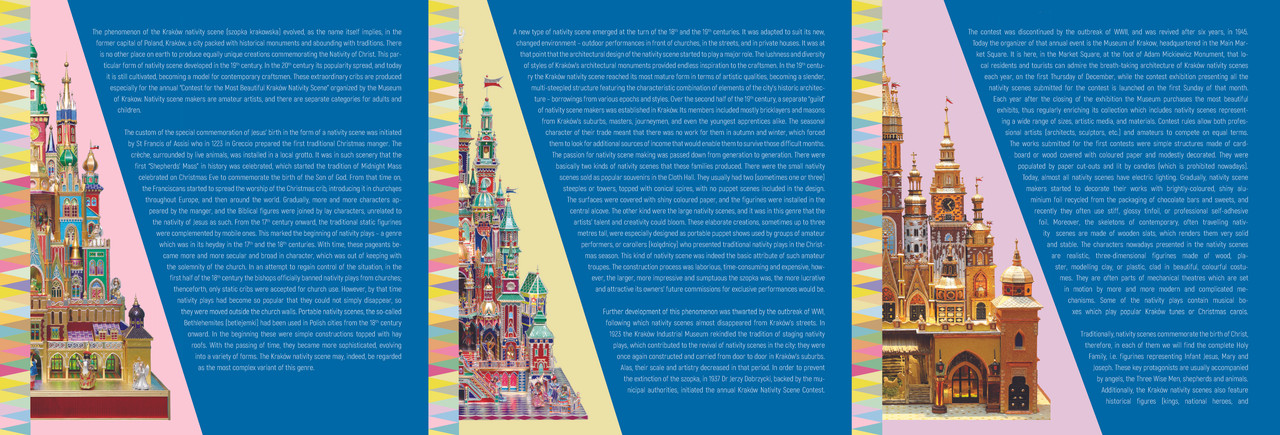
With Franciscans, the custom of organising nativity scenes also reached Krakow. In the eighteenth century, when moving puppet performances were banned in churches (some allegations emerged that their excessive liveliness and focus on secular issues were unsuitable for the stateliness of the temple), traveling Christmas shows developed. In the nineteenth century, a custom of walking around houses with the nativity scene became popular in Krakow. Masons from Krakow suburbs and surrounding villages of Krowodrza, Zwierzyniec, Grzegórzki, Dębniki or Ludwinów, made the greatest contribution to the development of that tradition. As they could not find employment during winter, they were looking for a source of income by constructing and selling nativity scenes. We can say that the Krakow nativity scene in its form known today developed in the second half of the nineteenth century, and the tradition of organising the Krakow Nativity Scenes Competition started in 1937. Today, looking at beautiful, multicoloured nativity scenes that we can admire at the post-competition exhibition, just like we do every year, we should remember the tradition that goes back centuries and the history that happened exactly 800 years ago, which contributed to their creation.
The nativity scene from Greccio
This nativity scene was brought for the 71st Nativity Scenes Competition in 2013 and donated for the collection of the Krakow Museum by the mayor of the town of Greccio, Ms Albertina Miccadei.
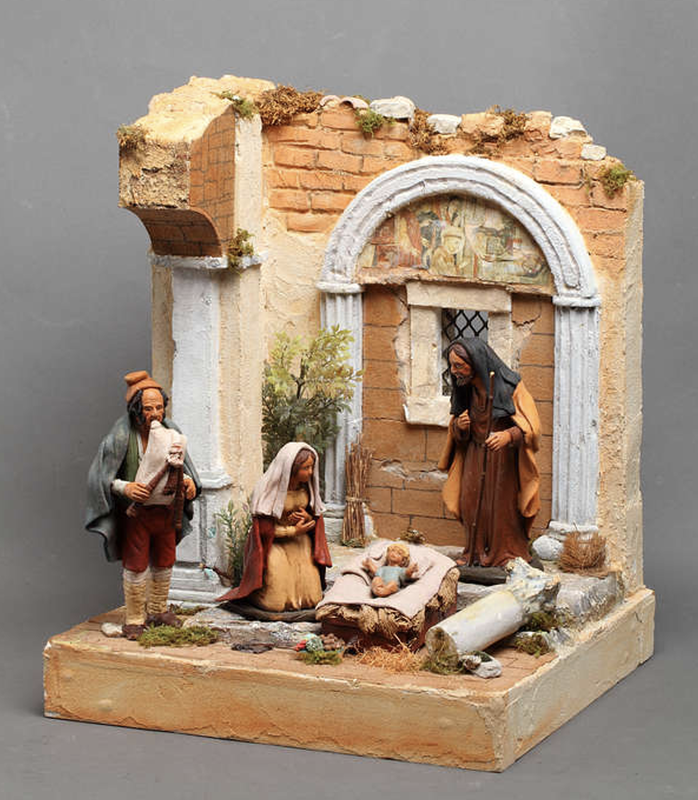
This unique nativity scene from Greccio refers to the tradition of the first Christmas play and Midnight mass, conducted by Saint Francis there in Greccio, in 1223. As Anna Szałapak wrote, ‘there is a hypothesis that the later French word for the nativity scene, crèche, originated from the name of that place, Greccio’. It is an example of a traditional Neapolitan nativity scene that is called presepio in Italy, from the Latin word praesepe, meaning a stable. Such nativity scenes appeared in Italy in the sixteenth century. The figures were arranged in a grotto that was to be built of stones coming from Bethlehem. In some Neapolitan nativity scenes, the background was formed by a textile painted with local landscapes; however, usually, three dimensional architecture inspired by Naples was used. Those nativity scenes presented rich tableaux, with people from different social classes performing their work. The most important part of the Neapolitan nativity scene is a grotto or a stable with the Holy Family. Frequently, ruins of Grecian or Roman temples were included, which were to refer to downfall of pagan beliefs. Shepherds, the Three Kings, or animals, usually were placed on hills created by the nativity scene author, which were frequently covered with real moss. Everything was handmade and meticulously crafted.
In the presented nativity scene from Greccio, the Nativity scene was placed against the ruins of the church in Greccio. Its one wall is in the background, with a portal and a fresco with Saint Francis in the arch area, a window with a grille below them, and a corner with a column and a pillar on the left. In the centre, Baby Jesus in a blue shirt lies in a mangle on a nappy, with Our Lady in a yellow dress, a red coat, and a white scarf on her head kneeling on his left. Beside her stands a shepherd playing bagpipes, in a white shirt, a green vest and red trousers, with a blue coat on his shoulders and a brown cap on his head. Saint Joseph stands at the back, on the right, dressed in a brown tunic and an orange coat, with a blue-grey scarf covering his head. A fragment of the church column lies on the right, near the Baby, with moss and grasses arranged around as a decoration. A basket of fruit stands in front of the mangle, and there is a bush and a bundle of wood in the corner of the ruins. Bricks in the walls, and terracotta and stones on the floor are visible as styled fragments of the church ruins.
Maciej Moszew (10 January 1940 – 27 July 2023)
Maciej Moszew, the longest working creator of Krakow nativity scenes, was born on 10 January 1940 in Krakow, as a son of Jan, a chemist and the Jagiellonian University professor, and Irena née Jabłońska. In interviews, he used to say: ‘I am from Krakow, the most beautiful city in the world. I was raised in Krakow traditions, in the Krakow family’. From the youngest age, he had been learning Krakow customs and celebrations, including the Lajkonik’s parade, the Emmaus indulgence fair, or nativity scene competitions.
He studied at several courses at the Kraków University of Technology, and graduated in architecture there in 1969. For many years, he had worked at various planning and design companies, including Biuro Projektów Przemysłu Skórzanego, Wojewódzkie Biuro Projektów, or Biuro Projektów „Społem”. In 1981–1985 and 1991–2000, he was a mechaniser at the Groteska Theatre in Krakow, and he was also employed at the arts workshop at the Helena Modrzejewska Stary Theatre. Throughout his life, he worked with many stage designers, creating mechanisms, puppets, and components of stage sets. He cooperated, among others, with Joanna Braun, Jan Polewka, and Jan Burnat. Just before his retirement, he taught modelling classes for students. Architecture, model building, mechanics – Maciej Moszew used skills gained in all these areas in his nativity scenes. ‘A nativity scene allows me to fulfil all dreams associated with artistic creations and manual work’, he said.
Going back to the beginning of his fascination with nativity scenes, he recalled nativity plays he had an opportunity to see at the Estreicher family and which greatly impressed him, as well as a nativity scene that his father made especially for him when Maciej was ill. It was a simple nativity scene cut out from carton, modelled after the master nativity scene of Michał Ezenekier. However, for Maciej it became a source of special memories, and it was what inspired him when he was constructing his first nativity scene for a competition in 1961. ‘I constructed first nativity scenes keeping them secret from my father, because he would box my ears, if he saw that I dedicated my time to that work, instead of studying’, he recalled in an interview from 2012. ‘So relying on the kindness of my colleagues, whom I officially visited to study, I constructed nativity scenes at places other than my home’. The secret was out when in 1964 his nativity scene won the second prize and its photograph was published in a newspaper.
For Maciej Moszew, the main source of inspiration was the old architecture of Krakow: Gothic, Renaissance, or Baroque. He spent a lot of time walking around the city with his camera, capturing details and later including them in his nativity scenes. He particularly valued the area of the Main Square, and towers of Saint Mary’s Basilica were a part of the majority of his nativity scenes. He emphasised his great love for Krakow on multiple occasions. ‘There is no finer city’, he used to say. ‘I live here, because it is where I have always wanted, and still want to live. I travelled a lot around Europe. I was fourteen times in Italy, in France, Switzerland, Belgium, the Netherlands, Austria, Greece… even in Africa. But the first thing I do on my return home, I always go to the Krakow Main Square’.
Maciej Moszew’s nativity scenes were famous for their complex mechanisms. As he admitted himself, sometimes he started his work with the mechanism, which he later ‘encased’ with the nativity scene. In his nativity scenes, all figures moved, and this required great precision. The characters were mostly traditional (like Mr Twardowski, Lajkonik, or the Wawel Dragon); the author avoided political or historical references. Figures of halberdiers guarding gates which, by letting other figures pass, ensured smooth movement of characters in the nativity scene, were very characteristic for his work. Shades of dark gold and gold decorations predominated, as, according to Maciej Moszew, the nativity scene should look like a ‘sparkling jewel’. All components were handmade, without any haberdashery used. The author strived to emphasise the geometry of the nativity scene, for example, with lines of threats decorating each window. ‘In making nativity scenes, I enjoy the most the possibility to design, to plan my own design with which nobody interferes, and to express my love for craft. It is fun for me, I enjoy it very much, I can spend hours on this’, he said about his work. ‘Considering that I am an amateur, my workshop is quite well equipped; I have drills, grinders, and even a lathe. This way, I am completely independent’. The impressive workshop of the artist had been perfected for many years: Maciej Moszew gathered there a great selection of all possible tools and materials required for construction of nativity scenes.
He specialised in small nativity scenes, for practical reasons. As he used to say himself, if he were to construct a large nativity scene with the same precision, this would take him at least several years. He spent from 800 to 1500 hours on constructing a small or medium-size nativity scene.
Construction of nativity scenes was his real passion; he used to say that it was this work that let him fully express himself. ‘I believe that a man with passion is more complete. A man without passion is empty. I do not know what I would do, if I did not make nativity scenes’, he said in an interview in 2012. He also convinced his daughter Magdalena, born in 1972, to learn this artistic craft, and as a child she participated in the competition six times.
He used to recall how important it was for him that in 1972, size classification of nativity scenes entered into the competition was introduced – when his small nativity scenes did not have to compete with large ones, he started to win more awards. And the number of awards won by Maciej Moszew is really impressive. He is the creator of nativity scenes who won the greatest number of awards: he won the first prize 37 times, the 2nd prize 15 times, the 3rd prize five times, the 4th prize once, and he was also awarded 10 recognitions. He participated in competitions continuously between 1961 and 2022. During his life, he constructed over 70 nativity scenes of various sizes. Apart from several scenes kept by the author, they became a part of numerous collections in Poland and abroad (including in Milan and in Bethlehem). Six of them are the highlight of the collection of the Museum of Krakow, and are shown during numerous travelling exhibitions. The author’s special achievement was construction of an extraordinary exhibition of the Krakow nativity scene in Paris in 1999. On the surface area of 60 m2, he presented entire Krakow as nativity scenes, with 140 moving puppets that enacted an 11-minute-long performance by Anna Szałapak, with lyrics by Agnieszka Osiecka and music composed by Zygmunt Konieczny.
Maciej Moszew’s achievements were recognised and highlighted with numerous awards. For his contribution to development of the Krakow nativity scenes tradition, he received the Medal of Saint Christopher from the Historical Museum of the City of Krakow in 2012. In 2017, he was awarded the Decoration of Honor Meritorious for Polish Culture. In 2018, he was entered into the Golden Book of Alumni by the Cracow University of Technology Alumni Association. In 2022, he was awarded the Decoration of Honoris Gratia for his outstanding efforts for the City of Krakow.
Talking about his father, who died in 1970, and who inspired him to became interested in nativity scenes as a small boy, Maciej Moszew recalled: ‘On is deathbed, he told me to make nativity scenes as long as I could. So I have been continuing this since 1961’. He kept his word: he did not miss any competition until his death. An unfinished nativity scene that he wanted to enter in the 81st. Nativity Scenes Competition, remained on the Master’s desk. Unfortunately, he did not live to participate in that competition – due to complication post heart attack, he died on 27 July 2023 and was buried at the Rakowicki Cemetery. He remained in memories of his family and friends as a real good friend.
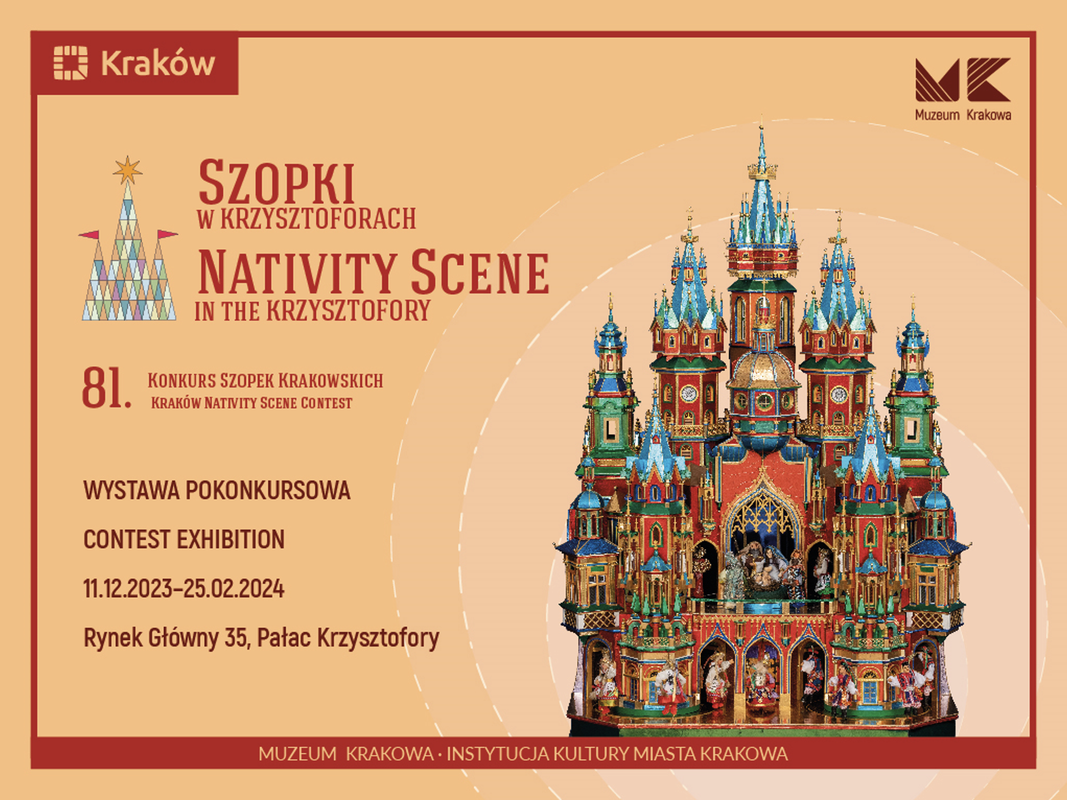
Nativity Scenes at the Krzysztofory Palace!
Exhibition: Cribs in the Krzysztofory Palace
Curator: Małgorzata Niechaj
Place: Krzysztofory Palace, Rynek Główny 35, Kraków
Duration: 11.12.2023 – 25.02.2024, 9:00 – 18:00
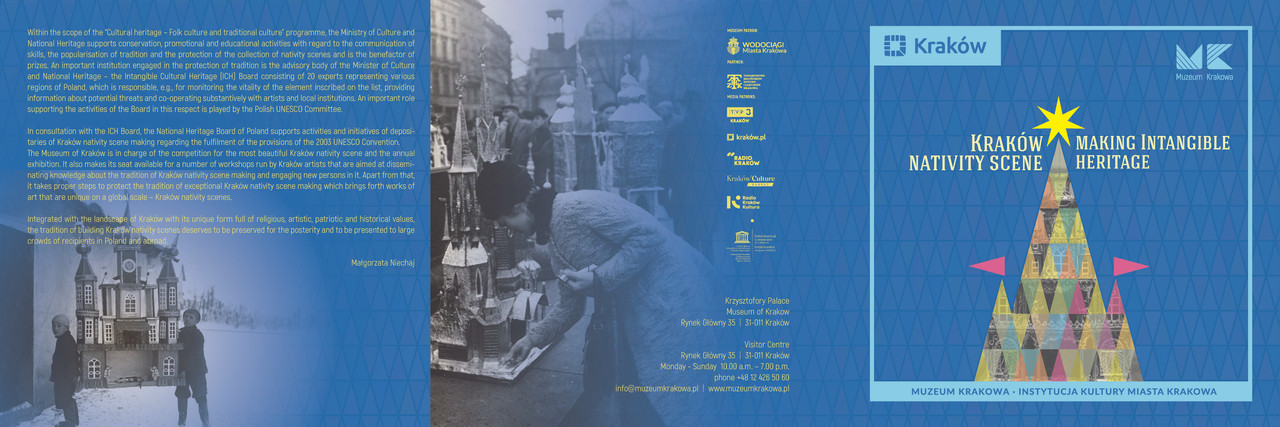
Kraków’s custom of “walking” around houses with a nativity scene dates back to the 19th century. However, after World War I, it began to slowly disappear. To preserve the Nativity Scenes tradition for future generations, Jerzy Dobrzycki, head of the magistrate’s propaganda department, organized the first Kraków Christmas Nativity Scenes Competition in 1937. After World War II, the competitions were resumed and their organization was undertaken by the Museum of Kraków, which continues the tradition to this day. The competition aims to preserve and develop the Nativity Scene tradition of Kraków, whose crystallized effect over several decades – the Kraków Nativity Scene – has become a worldwide phenomenon of established international renown and popularity. The competition is of great importance for the promotion and popularisation of this unique product of non-material heritage.
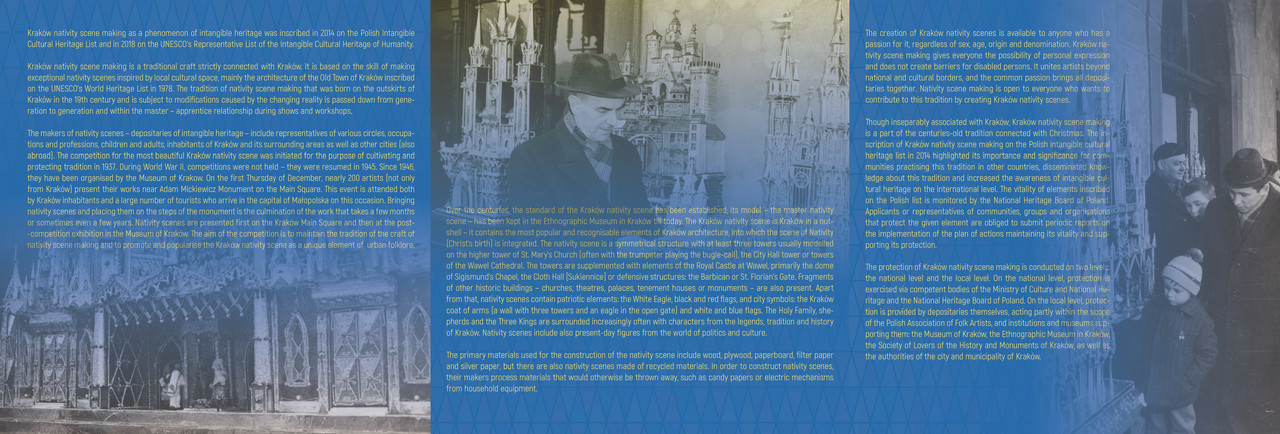
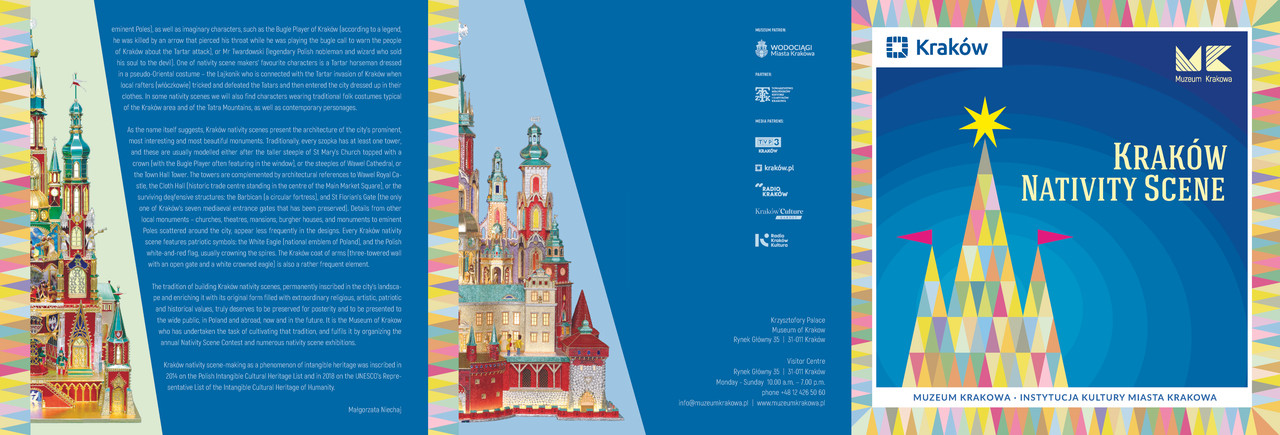
The Kraków Christmas Nativity Scene is a world-scale phenomenon. It is a slender, multi-level, tower-like, richly decorated building, constructed of light, non-permanent materials. It is characterized by an accumulation of fancifully transformed and interconnected miniaturized elements of Kraków’s historic architecture, into which the Christmas scene is set.
Every year on the first Thursday of December (this year on 7 December 2023), Nativity Scenes’s makers bring their works to the Main Square and place them on the steps of the Adam Mickiewicz Monument, where they can be admired from 10 a.m. to 12 p.m. After the Kraków bugle call at 12 p.m., a procession of Nativity Scenes sets off around the Market Square led by a folk band from Bronowice, which leads to the stage where the Nativity Scenes and Nativity Scenes’s makers are presented. Then, the creators move their works to the Krzysztofory Palace, where they will be judged by a jury of historians, ethnographers, art historians, architects, and artists.
The uniqueness of the phenomenon is underlined by its inclusion on the National List of Intangible Cultural Heritage in 2014. In addition, since 2018, the tradition of performing nativity scenes is the first entry from Poland on the UNESCO Representative List of the Intangible Cultural Heritage of Humanity.
The winners of the jubilee competition will be announced on 10 December 2023 at 2 p.m. at the Copper Room in the Krzysztofory Palace.
As tradition dictates, Kraków Nativity Scenes will be shown to the public from 11 December 2023 to 25 February 2024 in a post-competition exhibition at the Krzysztofory Palace.
The 81st Kraków Nativity Scenes Competition and the post-competition exhibition have received the honorary patronage of the Polish Committee for UNESCO.
The project was co-financed from the state budget – the funds of the Ministry of Culture and National Heritage.
[MK PRESS]