by dr. sc. Vendi Jukić Buča | May 17, 2013 | Autorski osvrti, Edukacija, Istaknuto, Izvan Hrvatske, Muzeji, Ostalo, SLO Narodni muzej Slovenije, Stručni, Susreti, U Europi
U okviru strateškog projekta ‘Arheološki parki Severnega Jadrana’, sufinanciranog u okviru Programa prekograničke suradnje Slovenija-Italija 2007-2013 iz sredstva Europskog fonda za regionalni razvoj i proračuna Republike Slovenije, u Narodnom muzeju – Metelkova, 15. svibnja 2013. godine, održana je obrazovna radionica ‘Management arheoloških parkov’.
Strateški projekt ‘Arheološki parki Severnega Jadrana’ (PArSJAd) povezuje tri slovenska i šest talijanska partnera s ciljem povećanja dostupnosti izabranih arheoloških nalazišta i arheoloških parkova, što obuhvaća uređenje lokacija, pripremu obrazovnih i interepretativnih programa, pripremu digitalnih sadržaja i promociju. U Sloveniji traju pilotski projekti na lokacijama Hrušica pri Podkraju, Mošnje pri Radovljici i Simonovom zalivu u Izoli.
Cilj radionice bio je ukazati na mogućnost kvalitetnog upravljanja arheološkim parkovima u svrhu doprinosa razvoju kulturnog turizma. Uređenje arheološkog nalazišta u kompleks arheološkog parka podrazumijeva management arheološkog nalazišta za posjetitelje – uređenje s intervencijama na nalazištu te pripremu i izvedbu tzv. mekih sadržaja koji povećavaju razumijevanje i individualni doživljaj. Radi svoje kompleksnosti i multidisciplinarnosti, arheološki parkovi predstavljaju zanimljivu ponudu ispunjavanja slobodnog vremena za cijelu obitelj. Glavni izazov upravljanja arheološkim parkovima je uspostavljanje primjerene ravnoteže između zaštite i očuvanja naslijeđa i njezine eksploatacije, sto se postiže povezivanjem različitih znanja, o kojima se govorilo na radionici. Radionica je okvirno bila namijenjena slušateljima koji su vlasnici arheoloških nalazišta, predstavnicima lokalnih vlasti, turističkim organizacijama, muzejima, lokalnim društvima i predstavnicima razvojnih agencija.
S obzirom na interdisciplinarnost pristupa razvoju strategije managementa arheoloških parkova predavači su bili stručnjaci iz više područja: arheologije, ekonomije, turizma i poduzetništva. Dr. Andreja Breznik (Narodni muzej Slovenije) govorila je o djelatnosti arheološkog parka i oblicima njegovih proizvoda, mag. Marko Stokin održao je predavanje o postupcima upravljanja s arheološkim naslijeđem, a umjesto najavljene izr. prof. dr. Irene Lazar (Inštitut za dediščino Sredozemlja Znanstveno-raziskovalnega središča Koper Univerze na Primorskem) predavanje o rimskoj vili u Simonovem zalivu održala je suradnica na projektu Katharina Zanier. Dr. Sonja Sibila Lebe (Ekonomsko-poslovna fakuteta Univerze v Mariboru) ukazala je na ulogu arheoloških parkova u kulturnotusrističkoj ponudbi, doc. dr. Aleksandra Brezovec (Fakulteta za turistične študije TURISTICA Univerze na Primorskem) opisala je održivost marketinga arheoloških parkova. Andreas Juhl (MBA, Trdnjava Ekertorp in Muzej okraja Kalmar) održao je predavanje iz Švedske preko Skype-a o upravljanju arheološkog područja tvrđave Eketorp, kraju ‘gdje se susreću turizam, obrazovanje i eksperimentalna arheologija’. Strategiju za rad s posjetiteljima predstavila je Tina Hiti spec. tur. (Tina Hiti s. p., Turističko vodenje in organizacija kongresne dejavnosti), a na samom kraju mag. Žiga Novak (MICE d.o.o. in Time Out Events) opisao je vještinu pripovijedanja priča.
Radionica je održana u dva dijela, s četiri aktivne diskusije i pauzom za ručak. Predavači su u potpunosti poštivali dozvoljeno trajanje predavanja u vremenu od 25 minuta te je radionica završila, kako je predviđeno, u 15.30.
Sudionicima su podijeljeni radni materijali uključujći CD s PowerPoint prezentacijama i predavanjima.
U Ljubljani, 17. 5. 2013., Vendi Jukić Buča
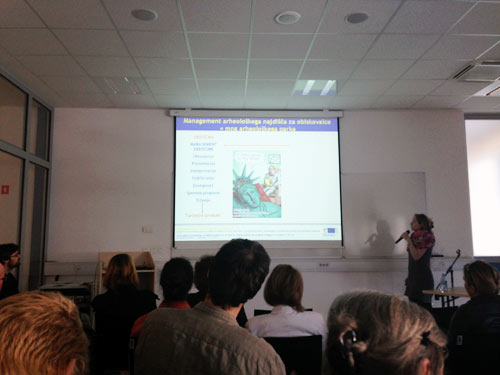
- PArSJAd – Obrazovna radionica ‘Management arheoloških parkov’ – Andreja Breznik. Foto: VJB.
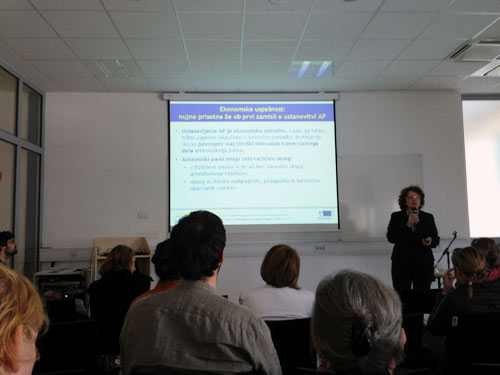
- PArSJAd – Obrazovna radionica ‘Management arheoloških parkov’ – Sonja Sibila Lebe. Foto: VJB.
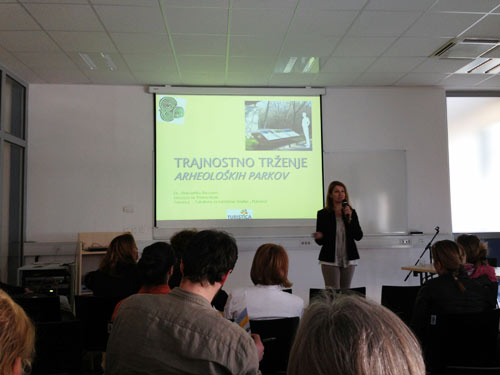
- PArSJAd – Obrazovna radionica ‘Management arheoloških parkov’ – Aleksandra Brezovec. Foto: VJB.
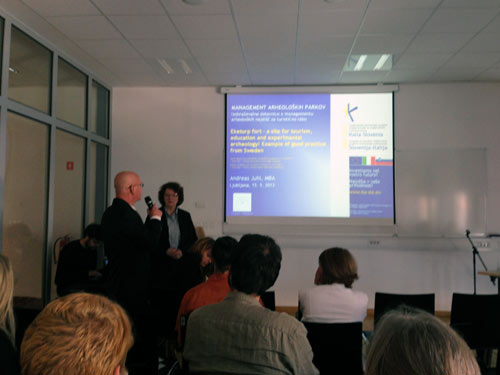
- PArSJAd – Obrazovna radionica ‘Management arheoloških parkov’ – Prva diskusija. Foto: VJB.

- PArSJAd – Obrazovna radionica ‘Management arheoloških parkov’ – Andreas Juhl. Foto: VJB.

- PArSJAd – Obrazovna radionica ‘Management arheoloških parkov’ – Kahtarina Zanier. Foto: VJB.

- PArSJAd – Obrazovna radionica ‘Management arheoloških parkov’ – Marko Stokin. Foto: VJB.

- PArSJAd – Obrazovna radionica ‘Management arheoloških parkov’ – Tina Hiti. Foto: VJB.

- PArSJAd – Obrazovna radionica ‘Management arheoloških parkov’ – Žiga Novak. Foto: VJB.
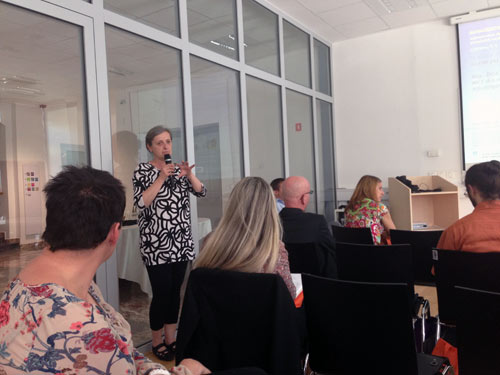
- PArSJAd – Obrazovna radionica ‘Management arheoloških parkov’ – Završna diskusija. Foto: VJB.
by PRESS | Apr 18, 2013 | Edukacija, Izvan Hrvatske, Muzeji, SLO Narodni muzej Slovenije, U Europi
Narodni muzej Slovenije u okviru projekta ‘ParSJAd – Arheološki parki severnega Jadrana’, koji je dio prekogranične suradnje Slovenija-Italija 2007-2013, organizira četiri besplatne radionice za ukupno 200 slušatelja na temu upravljanja arheološkim parkovima u Republici Sloveniji. Arheološki parkovi važno pridonose razvoju slovenskog kulturnog turizma pod uvjetom da su primjereno uređeni i upravljani. Upravo se ova znanja žele predstaviti na radionicama.
Više o radionicama pročitajte >ovdje.
Izvor
ParSJAd PRESS
by PRESS | Mar 21, 2013 | Edukacija, Izvan Hrvatske, Pozicije
CALL FOR APPLICANTS – DIG@LAB FOR THE DIGITAL KNOWLEDGE OF THE PAST
Research Associate
The Duke University DIG@LAB (Digital Digging) for the digital documentation, interpretation and reconstruction of the past, in partnership with Lions Club Reggio Emilia, seeks applicants for a research associate (or equivalent) fellowship focusing on scholarship in digital archaeology – Roman archaeology – and more specifically on the reconstruction of the ancient city of Regium Lepidi (now Reggio Emilia, Italy).
Applicants’ own research should involve the sophisticated use of one or more of the following: GIS, mapping and geo-spatial analysis; computer graphics; 3D modeling, computer vision and laser scanning; computer-aided drawing tools (CAD) and data visualization. In addition they should have a strong background in Roman archaeology and, possibly, on the above mentioned case study (Regium Lepidi). Applicants must be comfortable working in a collaborative research setting and have experience successfully participating in project management, curricular, and tool building teams.
We welcome applicants from art history, archaeology, anthropology, architectural history, history, anthropology, and digital humanities, as well as candidates from computer science with a strong interest and experience in multidisciplinary methods and the humanities.
The candidates should be able to speak fluent Italian and English, and to spend a considerable amount of time in Reggio Emilia and interact with all the local cultural institutions: the City Museum of Reggio Emilia (“Musei Civici”), the Soprintendenza Archeologica dell’Emilia Romagna and affiliated
institutions and as well in the US at Duke University.
The Research Associate will work full time on data collection (archives, libraries, maps, databases, digital data, GIS and so on), 3D digital data capturing of existing archaeological sites and digital post-processing and 3D reconstruction of the ancient Roman city of Regium Lepidi. The final product will be an interactive 3D virtual model in computer graphic of the Roman city able to run on specific VR platforms.
The candidate will spend about 50% of the fellowship time in Italy in Reggio Emilia and 50% in US at the Duke University/Classical and Visual Studies (under the supervision of Prof. Forte, Professor of Classical and Visual Studies at Duke). He/she will have full access to all the hardware and software, technological devices and facilities provided by the Dig@LAB and Visual Studies initiative at Duke.
The appointment is for twelve (12) months.
The total gross amount of the research fellow is 25,000 euro (paid in 12 monthly installments), inclusive of the cost for the round trip from Italy to the US (Raleigh-Durham Airport).
Open to applicants who have received their MA or BA in the last 6 years. Persons holding tenure-track appointments are ineligible to apply.
Applications will be considered through March 30, 2013.
Start date is May, 1st, 2013.
For further information please contact: PROF. MAURIZIO FORTE: maurizio.forte@duke.edu
APPLICANTS SHOULD SUBMIT THE FOLLOWING DOSSIER MATERIALS (in English) as a single PDF file (multiples files
won’t be accepted):
• Cover letter;
• Curriculum Vitae;
• Research Statement: A 150 words abstract, accompanied by a detailed narrative statement (no more than 1000 words). The narrative statement should explain how the proposed project would make a contribution to the applicant’s research and advance their larger field of study and the implications of the project for
digital archaeology scholarship more broadly.
• Dissertation abstract;
• Writing Sample: (no more than 25-pages);
• Sample of Digital Scholarship: The applicant should provide a link to a sample of his or her digital scholarship;
• The names and contact information for three references. These references should be established scholars who are familiar with the applicant’s work and the proposal being made for the fellowship. At least two of these references must be scholars who can speak to the applicant’s engagement with the field of digital
humanities.
Send application materials to (email’s subject “Regium Lepidi”): maurizio.forte@duke.edu
Izvor
ROSA
by PRESS | Mar 4, 2013 | Edukacija, Izvan Hrvatske, Pozicije
Prenosimo službeno priopćenje.
The Department of Sociology & Anthropology invites applications for a Postdoctoral Teaching Scholar in anthropology. Ability to teach upper division courses in the candidate’s specialty, and some experience in teaching introductory courses in archaeology is preferred. Successful applicants should demonstrate motivation to teach and mentor undergraduate students, and show evidence of an ability to publish research in their substantive specialty. The Postdoctoral Teaching Scholar will be expected to teach two courses each semester and the Scholar will also be expected to pursue their own research agenda. This is a one year position with the possibility of renewal.
Ph.D. in hand is required at time of appointment, and the applicant must have received their Ph.D within three years of the date of appointment. To apply to the position, please visit the job posting on NC State’s website: http://jobs.ncsu.edu/postings/18704 . After submitting the application, applicants should submit a letter of application addressing current and future teaching and research interests, along with curriculum vitae and sample teaching evaluations (if applicable) to: Dr. Tim Wallace, Postdoctoral Teaching Search Committee, Box 8017, Department of Sociology & Anthropology, NC State University, Raleigh, NC 27695, tim_wallace@ncsu.edu. We will begin reviewing applications on March 31, 2013. NC State is an equal opportunity/affirmative action employer. Applications from women and members of minority groups are strongly encouraged.
John K. Millhauser
Assistant Professor
Department of Sociology & Anthropology
North Carolina State University
millhauser@ncsu.edu
Izvor
ROSA
by PRESS | Dec 12, 2012 | Edukacija, Izvan Hrvatske, Stipendije
A PhD studentship is available for the NSERC-funded program: ” Pliocene dinoflagellate cysts, geochemistry, and paleoceanography of the North Atlantic region” in the Department of Earth Sciences, University of Toronto, Canada.
Application deadline: January 15, 2013.
Description of PhD project:
The North Atlantic Current (NAC) and thermohaline circulation are major drivers of global climate change, transferring heat and moisture to high northern latitudes. Moisture is necessary for ice sheets to accumulate, thereby increasing albedo and causing global temperatures to drop. Hence, the Northern Hemisphere, through its capacity to grow extensive continental ice sheets, has been a major amplifier of global climate change at least since the Late Pliocene. The changing dynamics of the NAC and polar front are accordingly critical to our understanding of past and future climates.
The project will focus on several discrete intervals of the Pliocene, including Marine Isotope Stage (MIS) M2 which occurred 3.29 million years ago and represents the first severely cold episode of the Pliocene. Described as an early failed attempt by the climate system to reach a full glacial state, MIS M2 represents significant instability in the NAC (e.g. De Schepper, Head & Groeneveld, 2009) that was followed immediately by sustained warmth in the early Late Pliocene. Additional time slabs during the Early and Late Pliocene will be chosen to address the impact of progressive restriction and closure of the Central American Seaway on North Atlantic circulation. The successful candidate will have the flexibility to choose specific time slabs and sites.
A novel combination of proxies (dinoflagellate cysts, alkenones, foraminiferal Mg/Ca ratios and oxygen isotopes, ice-rafted debris) will be used to reconstruct sea-surface temperature, salinity, evidence of ice melting, and NAC strength. The resulting reconstructions will provide boundary conditions for NAC shutdown/recovery, and will be used in conjunction with the HadCM35 coupled ocean-atmosphere general circulation model to simulate conditions during MIS M2 and other time slabs.
The project, under the supervision of Prof. Martin J. Head, will include collaboration with Dr Stijn De Schepper (Bergen University, Norway), Dr Jeroen Groeneveld (Bremen University, Germany), and Prof. Alan Haywood (University of Leeds, UK). It is scheduled to begin September 2013.
Recent literature relevant to project:
De Schepper, S., Head, M.J., Groeneveld, J. 2009. North Atlantic Current variability through marine isotope stage M2 (circa 3.3 Ma) during the mid-Pliocene. Paleoceanography, 24: DOI: 10.1029/2008PA001725.
De Schepper, S., Fischer, E., Groeneveld, J., Head, M.J., and Matthiessen, J., 2011. Deciphering the palaeoecology of Late Pliocene and Early Pleistocene dinoflagellate cysts. Palaeogeography, Palaeoclimatology, Palaeoecology, 309: 17-32.
How to apply:
The on-line application for admission to the Fall (September) 2013 session at the University of Toronto, Graduate Department in Geology, is now available.
1) Please go to the Earth Sciences website at http://www.geology.utoronto.ca
2) Click on the Graduate Studies photo
3) Scroll down to Prospective Students
4) Click on HOW TO APPLY, read carefully and follow the instructions.
Although the application deadline is January 15, 2013, please check the on-line application for admission NOW to determine how much time is needed to assemble all the necessary documentation. For any questions relating to this project, please contact Prof. Martin J. Head (mhead@brocku.ca ).
Zahvaljujemo Maji Andrič (ZRC SAZU) na informaciji.
by PRESS | Oct 7, 2011 | Muzeji, Seminari, SLO FF Ljubljana - Oddelek za arheologijo, Susreti
Kulturne in družbene identitete v mezolitiku in neolitiku Evrazije /
18. neolitski seminar
Kuturni i socijalni identiteti u mezolitiku i neolitiku Euroazije
U organizaciji:
Oddelek za arheologijo
Filozofska fakulteta
Univerza v Ljubljani
18. neolitski seminar održavat će se na Odsjeku za arheologiju Filozofskog fakulteta u Ljubljani. Tema seminara su kulturni i socijalni identiteti u mezolitiku i neolitiku Euroazije.
Program
Friday, 11th November
Morning session (9.00- 13.00)
Moderator: Dr. Bernhard Weninger
Mihael Budja
Department of Archaeology, University of Ljubljana, Slovenia
Introduction to the conference
Mark J. Hudson
University of West Kyushu, Japan
‘Austronesian’ and ‘Japanese’ in the Neolithic of the southern Ryukyu Islands
Takamune Kawashima
Department of Asian and African studies, University of Ljubljana, Slovenia
Increasing regional diversity of production and emerging local identities
Erick Robinson and Philippe Crombé
Department of Archaeology, Ghent University, Belgium
The Rhine-Meuse-Scheldt Mesolithic: a socioecological approach
Discussion & coffee/tea
Penny Bickle1, Alex Bentley2, Robert Hedges3, Julie Hamilton3, Linda Fibiger3, Geoff Nowell4, Christopher Dale4, Daniela Hofmann1 and Alasdair Whittle1
1Archaeology and Conservation, Cardiff University UK, 2Department of Archaeology and Anthropology, University of Bristol, UK, 3School of Archaeology, University of Oxford, UK, 4Department of Earth Sciences, University of Durham, UK
Diversity in cultural identities and regional variation in the Early Neolithic? The story from isotopic analysis
Roderick B. Salisbury
School of Archaeology and Ancient History, University of Leicester, UK
Place and identity: networks of Neolithic communities in Central Europe
Katerina Psimogiannou
Department of Archaeology, Aristotle University of Thessaloniki, Greece
Creating identities in the mortuary arena of the Greek Final Neolithic: a contextual definition of the practices in Central and Southern Greece
Evita Kalogiropoulou
Department of Archaeology and Conservation, Cardiff University, UK
Forming social identities in Neolithic Northern Greece: a spatial approach
Discussion & lunch
Afternoon session (14.30- 18.30)
Moderator: Dr. Penny Bickle
Goce Naumov
Institute for History of Art and Archaeology, University of Skopje, Republic of Macedonia
Regional perspectives of Neolithic corporeality in the Republic of Macedonia
Alenka Tomaž1 and Ljubo Fidanoski2
1Science and Research centre Koper, Institute for Mediterranean Heritage, University of Primorska, Koper, Slovenia, 2Museum of the City of Skopje, Republic of Macedonia
Houses and households identities at Neolithic Cerje – Govrlevo, Republic of Macedonia
Radmila Balaban
Department of Archaeology, Belgrade University Belgrade, Serbia
Use and reuse of the house – reconstructing the social structures in the Neolithic
Discussion & coffee/tea
Adam N. Crnobrnja
Belgrade City Museum, Belgrade, Serbia
Group identities in the Late Neolithic in the Central Balkans
Marko Porčić
Department of Archaeology, University of Belgrade, Serbia
Social complexity and inequality in the Late Neolithic in Central Balkans: reviewing the evidence.
Roberto Micheli
Superintendence to archaeological properties of Friuli Venzia Giulia, Trieste, Italy
Personal ornaments, Neolithic groups and social identities: insights into the Neolithic of Northern Italy
Konstantinos Trimmis and Elezi Gazmend
Department of Archaeology, Aristotle University of Thessaloniki, Greece
Who is the Caveman? Identities and roles of the Aegean Neolithic cave users
Dimitrij Mlekuž, Milena Horvat and Mihael Budja
Department of Archaeology, Faculty of Arts, Ljubljana University, Slovenia
Mala Triglavca: material practices, identity and community
General discussion
Saturday, 12th November
Morning session (9.00- 13.00)
Moderator: Dr. Dimitrij Mlekuž
Alja Žorž
Institute for the Protection of Cultural Heritage of Slovenia, Preventive Archaeology Centre, Ljubljana, Slovenia
Social identity in the megalithic ritual landscape
Miloš Spasić
Belgrade City Museum, Belgrade, Serbia
Cattle to settle – bull to rule: on bovine iconography among Neolithic Vinča culture communities
Selena Vitezović
Archaeological Institute, Belgrade, Serbia
Jewellery from osseous materials in Starčevo culture
Discussion & coffee/tea
Bernhard Weninger
Institute of Prehistory, University of Köln, Germany
Radiocarbon choreography: revolutions, dates and dogmas
Marko Sraka
Department of Archaeology, Faculty of Arts, Ljubljana University, Slovenia
14C dates and cultural sequences – case studies from continental Slovenia and contradictions in selected cultural schemes of Central and South-east European Neolithic and Eneolithic cultures
Anett Osztás
Institute of Archaeology, Hungarian Academy of Sciences, Budapest, Hungary
A major site in Neolithic Europe: Alsónyék-Bátaszék, Southeastern Transdanubia (Hungary)
Mira Strmčnik Gulič1 and Bine Kramberger2
1Institute for the Protection of Cultural Heritage of Slovenia, Preventive Archaeology Centre, Maribor, Slovenia, 2Bistrica ob Dravi, Slovenia
Late Neolithic/Eneolithic settlement Zgornje Radvanje
Alenka Tomaž
Science and Research centre Koper, Institute for Mediterranean Heritage, University of Primorska, Koper, Slovenia
Eneolithic site at Turnišče in Prekmurje
Afternoon session (14.30- 18.30)
Moderator: Dr. Alenka Tomaž
Marija Lubšina Tušek1 and Boris Kavur2
1Institute for the Protection of Cultural Heritage of Slovenia, Preventive Archaeology Centre, Ptuj, Slovenia, 2Science and Research centre Koper, Institute for Mediterranean Heritage, University of Primorska, Koper, Slovenia
Pits and holes. Early Copper Age architecture in Eastern Slovenia
Phil Mason
Institute for the Protection of Cultural Heritage of Slovenia, Preventive Archaeology Centre, Ljubljana, Slovenia
Settlement and place in the Neolithic and Eneolithic of Central and South-eastern Slovenia
Irena Šinkovec
City Museum Ljubljana, Slovenia
Pile-dwelling at Špica in Ljubljana
Discussion & coffee/tea
Boris Kavur
Science and Research centre Koper, Institute for Mediterranean Heritage, University of Primorska, Koper, Slovenia
Go West! Sustained traditions and changed identities in the process of colonization of new territories
Rajna Šošić Klindžić1, Jacqueline Balen2, Tomislav Hršak3, Davor Špoljar4
1Department of Archaeology, University of Zagreb, Croatia, 2Archeological Museum Zagreb, Croatia, 3Archaeological Museum Osijek, Croatia, 4Zagreb, Croatia
Local differences reflected through everyday activities in Stone Age Slavonia: examples from Virovitica-Brekinja, Tomašanci-Palača and Kaznica-Rutak
Vasilka Dimitrovska
Skopje, Republic of Macedonia
The system of local supply for stone tools in Amzabegovo-Vršnik culture
General discussion and closing remarks
archaeology | neolithic seminars
Izvor
FFUL PRESS